Biomimicry helps scientists steal…I mean learn…from the natural world. Businesses, on the other hand, have another rich source of lessons: their own blunder-filled histories. Most businesses get gobbled by the meat-eating market of capitalism because they fail to learn from previous mistakes.
That’s why we are both still reading this. The twentieth century gave us plenty of examples of ambitious plans meeting inconvenient realities. This blunders series will reveal what people assumed, what they measured and how their systems responded when things went wrong, but something more interesting will evolve from this insight: have the business decisions of today learned from the blunders of the past?
This series follows the operational value chain, led by an operational leader, from the initial vision to cash delivery, with one story at each stage. We will focus on the 20th century and will continue to explore other centuries in a subsequent series. Along the way, we’ll learn how one team’s decisions can become another team’s challenges.
Whether you’re a leader, an aspiring leader or simply curious, you may recognize your own experiences in these stories or sympathize with the flaws of our shared human experience. Read the stories, enjoy the absurdity, and pause at the reflection. As Oscar Wilde wrote of experience, it was “merely the name men gave to their mistakes.” [1]
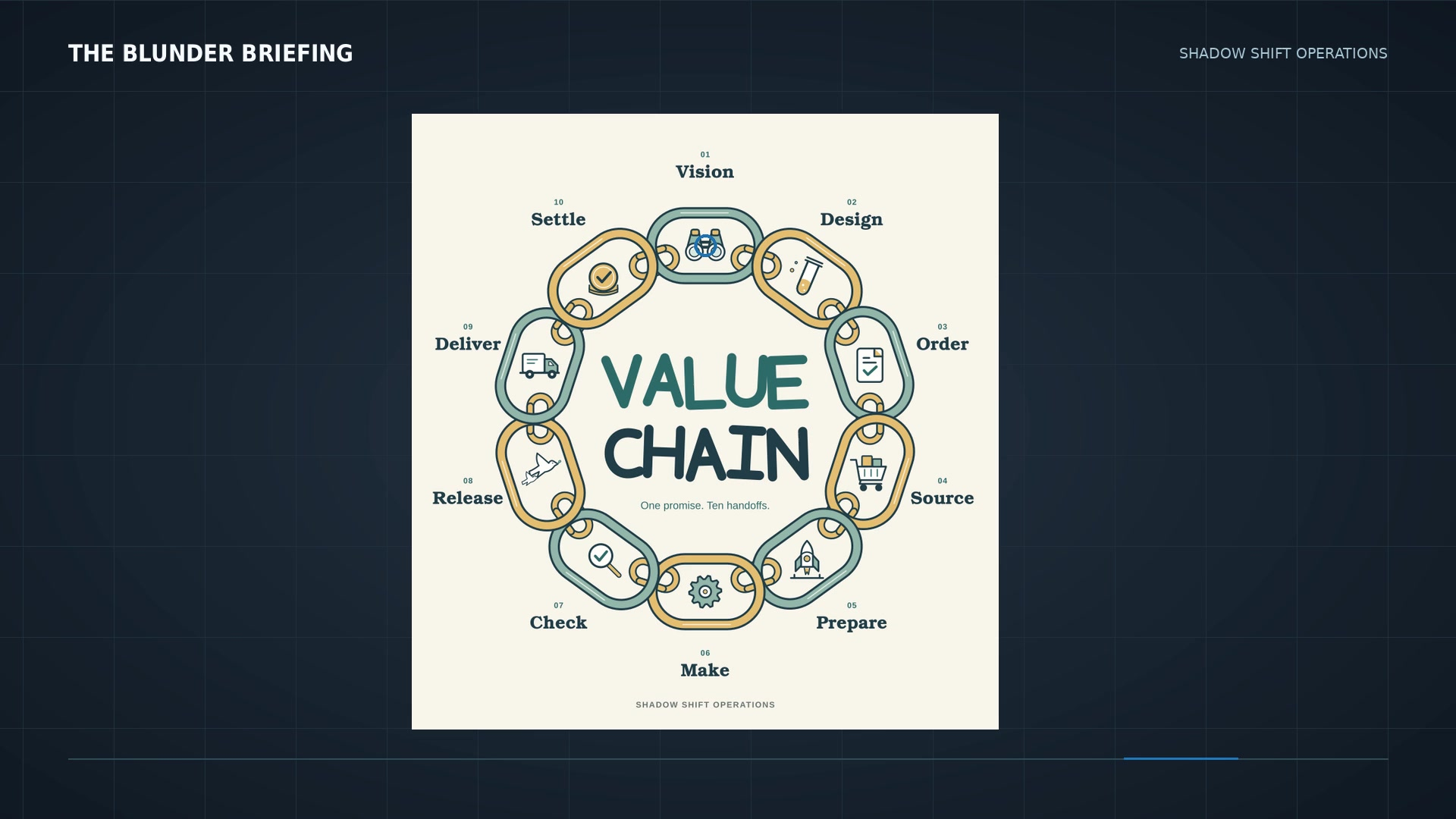
For this week, we’re beginning with Vision & Strategy, where an idea becomes more than a pinky swear—It becomes a real commitment. Today’s story is about Fordlandia from 1928, and the question we’ll explore is which strategic assumptions need proof before committing to the vision.
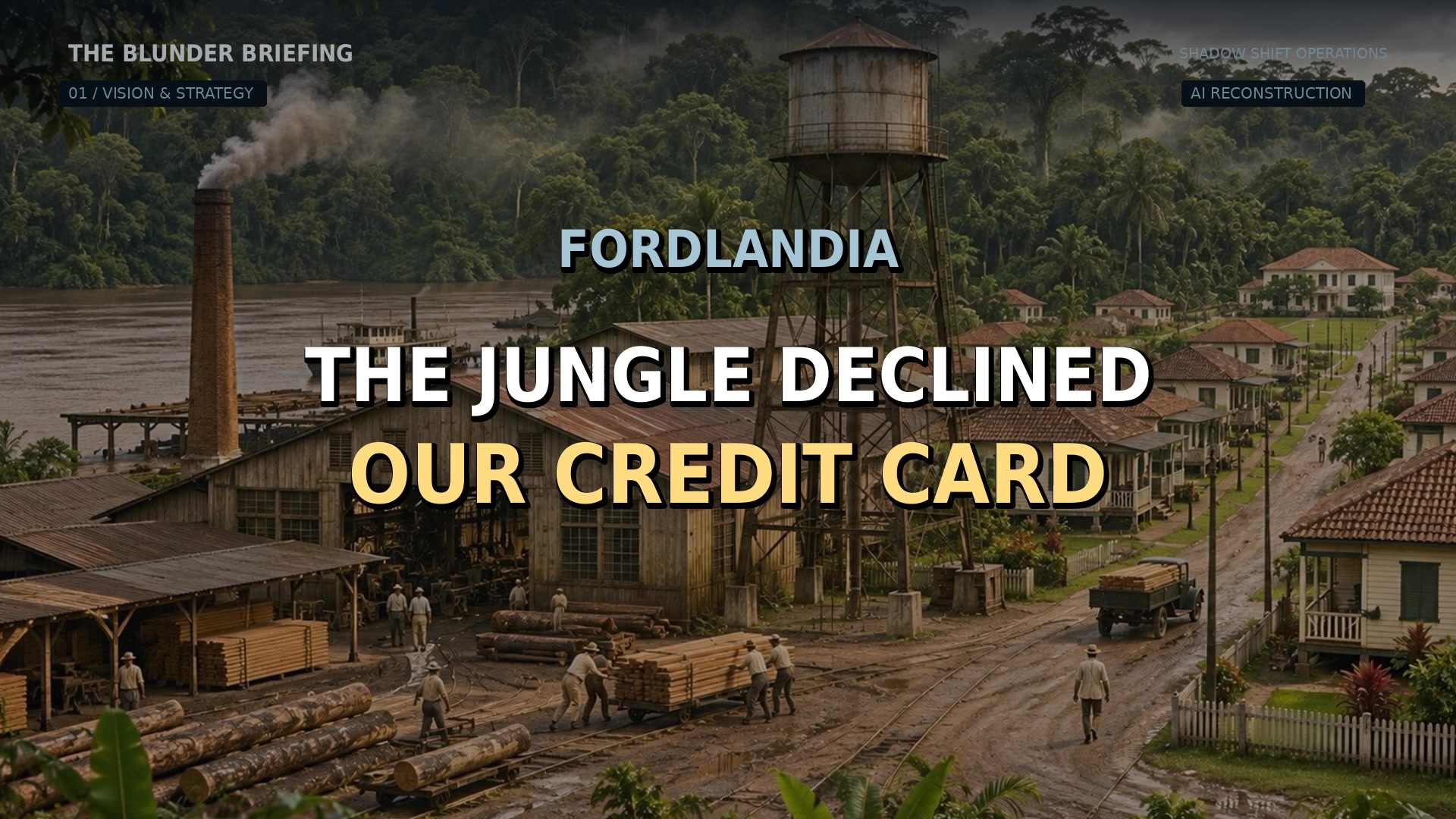
In the early 20th century, car production was booming, horse droppings in the streets were becoming scarcer, and Henry Ford needed to supply rubber for its car factories in the United States and decided to build a company town in the wild Amazon with the goal of reducing costs. But, he underestimated how difficult it is to grow rubber in that jungle environment. Tree disease, soil problems and imposed American work routines on Brazilian workers undermined the venture. [2] [3] A gentle reminder to some of the readers that not every aspect of American culture is always great.
Ford later shifted activity to Belterra but ultimately sold both plantations back to Brazil in 1945, making the move a significant waste of time and resources. [2] There, of course, was research before development in the Amazon: Ford commissioned an independent study of the Tapajós River valley in 1926. [2] The existence of a study, however, leaves an important question open: how well did its findings support the particular vision that Ford went on to build? You might guess it was like putting a square block into a round hole.
The study did not look at whether the American food diet or the 8-hour workdays, with shrieking factory whistles, would be accepted by the local populations, and Ford failed to sympathize that working entire shifts in amazon heat is not the same as working inside a factory in the U.S. [3] [4] [5] I will note that US factories weren’t exactly the Ritz but you get the point.
This is why “Vision & Strategy” is a useful lens.
A staffing problem or an agricultural problem becomes harder to resolve when the original vision treats the operating model as settled—my way or the highway. The strategic discipline is deciding which parts of the plan remain hypotheses, what evidence would justify scaling them, and how systems can be built to evolve with changing environments.

Now imagine a company choosing a location for, let’s say, a new AI data center. This is a hypothetical example, with a hypothetical company named Microcough, but the decision pattern is familiar. Stay with me here.
As planning advances, the utility identifies a constraint such as a proposed cooling system that depends on local water availability that remains uncertain. Permits and community concerns tack on more timeline delays, but the opening date remains more certain than the water or electricity sources.
The parallel with Fordlandia concerns the transfer of assumptions between locations. As data centers today expand into new territories, they will certainly face different technical challenges from a rubber plantation, but the shared question is whether previous success provides enough evidence to commit to a new setting.
Now let’s circle back to you because that’s why we’re both here. In your line of work or home life, before you approved the next expansion, did you ask the team to identify the assumption that would cause the most damage if it proved wrong? “The location will work” is too generic. “The utility can provide the required capacity by our planned opening date” should give someone an opportunity to verify. Or “I definitely turned the stove off.” Whatever it is, don’t be offended by verification, especially if you’re in operations. Otherwise, become an artist or something.
Anyways, ask who has the closest knowledge of that condition. Bring that person into the decision. Give them room to challenge the proposed schedule or location, and record what remains uncertain. If the evidence supports the requirement, proceed. If it supports a different timeline or configuration, revise the plan. If a critical condition cannot be met, reconsider the location. Boom, there you have it.
Simple, right? It’s always easier said than done when navigating workplace politics.
Applied to Fordlandia, the equivalent would involve agricultural evidence and local knowledge before expanding the plantation model. Small tests cannot remove every uncertainty, particularly when growing cycles take years. However, they can make uncertainty visible before the commitment becomes harder to change.
Overall, the 20th century changed the available tools in our proverbial toolbox. Horses gave way to spacecraft, and paper piles to electronic datacenters. However, better equipment still depends on sound business assumptions and people who understand how the individual parts fit into the larger system. Like Darwin’s finches from the Galapagos Islands, business models must evolve to the changing environment.
The 21st century will bring its own set of blunders, but we’ll be ready with our knowing smiles. Until next week, remember to keep your blunders visible. You got this.
Sources and notes
- [1] Oscar Wilde, The Picture of Dorian Gray, Chapter IV. Public-domain text, reproduced by The Literature Page. Source of the quoted phrase about experience and mistakes.Read source
- [2] The Henry Ford, Ford Rubber Plantations in Brazil. Supports the 1926 independent study, the plantation history, agricultural difficulties, the shift to Belterra and the 1945 disposal.Read source
- [3] The Henry Ford, Fordlandia, Google Arts & Culture exhibition. Supports the rubber-supply objective, eight-hour days including the hottest hours, local resistance and the 1945 sale under Henry Ford II.Read source
- [4] Greg Grandin, Fordlandia, Chapter 15 excerpt, NPR / North Country Public Radio, July 29, 2009. Documents factory whistles, time clocks and the conflict between industrial schedules and local environmental rhythms. The food issue is also covered in source 2.Read source
- [5] Source limitation: sources 2–4 establish that a study existed and that food and scheduling conflicts followed. They do not establish whether the 1926 study examined acceptance of American diets or eight-hour shifts. The sentence asserting what the study did not examine remains unverified; the author’s wording has been retained.